Blog
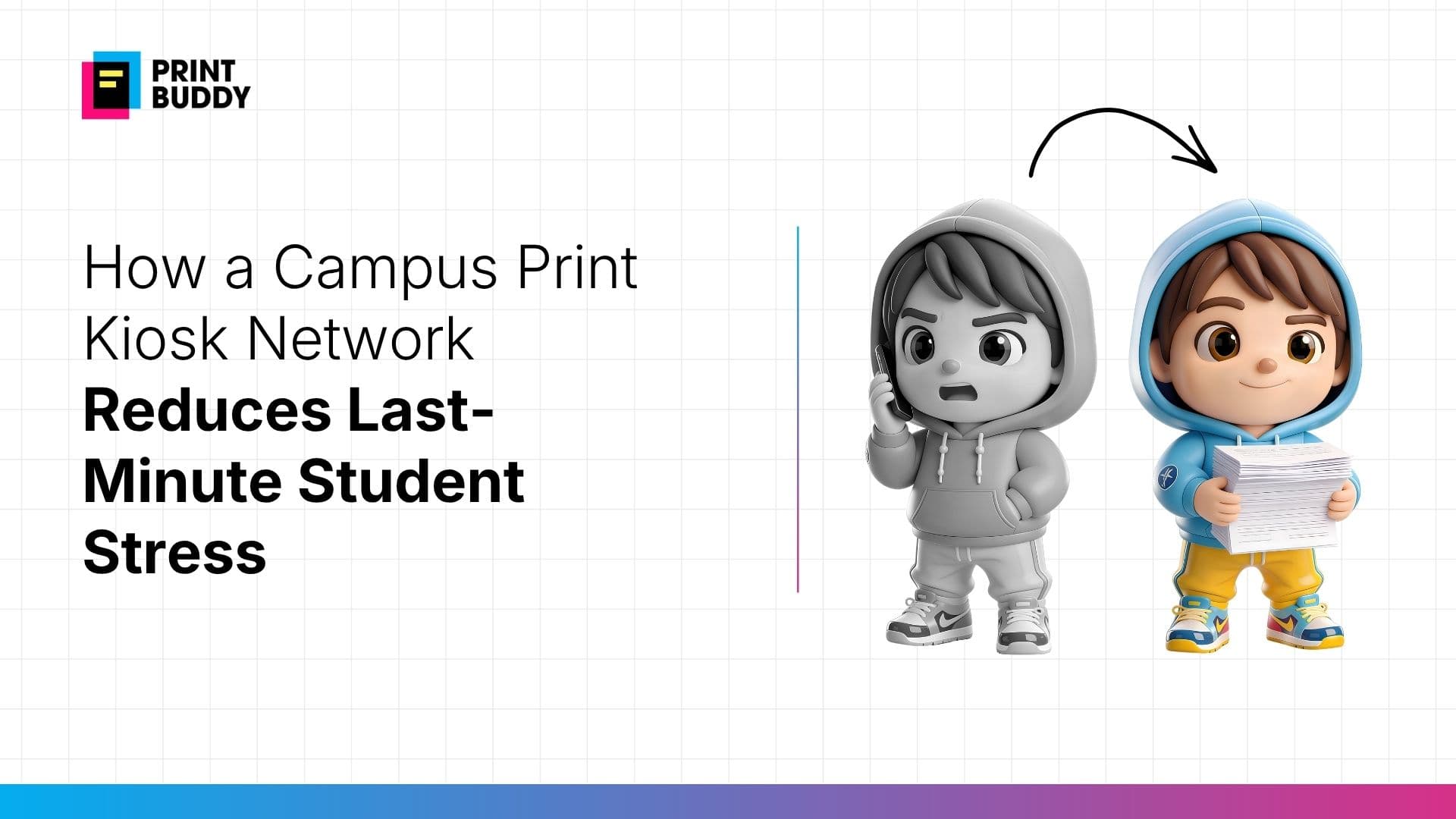
How a Campus Print Kiosk Network Reduces Last-Minute Student Stress
Key Takeaways
● Last-minute printing stress comes from uncertainty, not just urgency.
● A distributed print kiosk network reduces dependency on a single location.
● Students need access to printing wherever they are, not just where printers exist.
● Pay and print and mobile-first workflows reduce delays during urgent moments.
● A self service printing kiosk network improves both speed and confidence. Stress doesn’t come from printing — it comes from uncertainty Most students are used to working under time pressure. Deadlines, last-minute edits, and quick turnarounds are part of campus life. Printing itself is not the stressful part. What creates stress is everything around it. Not knowing:
● where to print
● whether the system will work
● how long it will take
● whether there’s a backup option That uncertainty is what turns a simple task into a stressful one. Why single-point systems fail under pressure Many campuses still rely on a limited number of printing locations. On regular days, this may feel manageable. But during deadlines, it creates pressure points. You often see:
● long queues forming at a single location
● delays building up quickly
● students waiting without clear timelines
● last-minute rushes overwhelming the system When everything depends on one place, even small disruptions affect everyone. What changes with a kiosk network A print kiosk network spreads access across campus. Instead of relying on one or two locations, students have multiple points where they can complete the same task. This changes behaviour in a simple but important way:
● students go to the nearest available kiosk
● load is distributed naturally
● queues are shorter and more manageable
● no single point becomes a bottleneck The system becomes more resilient without needing to increase complexity. Access where the need happens Printing demand does not originate from one place. It happens across campus:
● inside academic buildings
● in libraries during study sessions
● near hostels late at night
● between classes in high-traffic corridors A distributed network aligns with this reality. Students don’t need to plan where to go. They use what is closest when the need arises. That alone removes a significant amount of stress. Why preparation before reaching the kiosk matters A network works best when combined with a structured workflow. Students should be able to:
● upload documents using print with mobile
● select preferences in advance
● complete pay and print before arriving
● collect output quickly from a self service print kiosk This reduces the time spent at each kiosk. When multiple students are using the system at once, shorter interactions keep everything moving. How this reduces last-minute pressure In urgent situations, even small delays feel amplified. A kiosk network helps reduce that pressure in a few key ways:
● fewer queues at any single point
● faster movement through each interaction
● less dependency on staff or coordination
● more confidence that an alternative is nearby Students don’t feel stuck. They feel like they have options. Confidence changes the experience When students know there are multiple reliable printing points, their behaviour changes. They don’t:
● panic if one kiosk is busy
● rush unnecessarily to a single location
● search for print out near me
● depend on external options at the last minute Instead, they move through the process calmly, knowing the system will support them. That confidence is what reduces stress more than anything else. Why networks scale better than individual setups A single kiosk, no matter how efficient, has limits. A network scales naturally. As demand increases:
● usage spreads across locations
● pressure is distributed
● the system adapts without intervention This makes the overall experience more stable, especially during peak submission hours. The shift from bottlenecks to flow Without a network, printing creates bottlenecks. With a network, printing becomes part of campus flow. Students move from one task to another without interruption. Printing fits into that movement instead of slowing it down. That is the real difference. When printing stops adding pressure The goal is not just faster printing. It is removing printing as a source of stress altogether. When a campus print kiosk network is designed well:
● students don’t worry about access
● they don’t plan around printing
● they don’t build backup options They simply complete the task and move on. Tags self service printing kiosk print kiosk document printing kiosk self service print kiosk smart print kiosk pay and print print with mobile instant print kiosk print out near me online print near me